


Rated 4.9 (35,000+)


Days 1-3
The Shield
- The raft mechanism goes to work quickly after dosing. Burning after meals may feel calmer as the barrier support starts.


WARNING: Low Stock Notice
Arvia® Gut Barrier Repair sells out fast during sale periods. We encourage you to take advantage of the limited sale and order now. PS: Only available here, don't buy fakes on Amazon/eBay.


It is not that you need to try harder. Many common approaches do not address the mechanical pathway that allows reflux to keep returning.

You took antacids after every meal.
Why it can fail: temporary acid neutralization does not create a lasting barrier at the valve.

You tried PPIs or acid blockers.
Why it can fail: suppressing acid is different from blocking upward movement at the source.

You cut out your favorite foods.
Why it can fail: diet changes may reduce triggers but cannot physically seal a weak reflux pathway.
Arvia combines six purposeful ingredients to support a complete reflux-restoration routine: a physical raft barrier, gut-lining support, and motility support.

Sodium Alginate 500mg
Forms a floating gel raft that caps the acid pocket and blocks reflux at the source.
Calcium Carbonate 150mg
Strengthens the raft structure and neutralizes acid on contact.
Sodium Bicarbonate 30mg
Creates the lift that helps the raft rise to the acid pocket.
Zinc-L-Carnosine 37.5mg
Binds to damaged tissue and supports esophageal lining repair.
DGL Licorice 80mg
Supports the natural protective mucus layer of the esophagus.
Ginger Extract 40mg
Supports gastric motility and helps reduce the pressure that pushes acid upward.
Together, these phases help support:
acid-pocket shielding, reflux-source blocking, preserved natural acid production, gut-lining support, and optimized motility.
60-day money-back guarantee
Honest experiences with Arvia Gut Barrier Repair
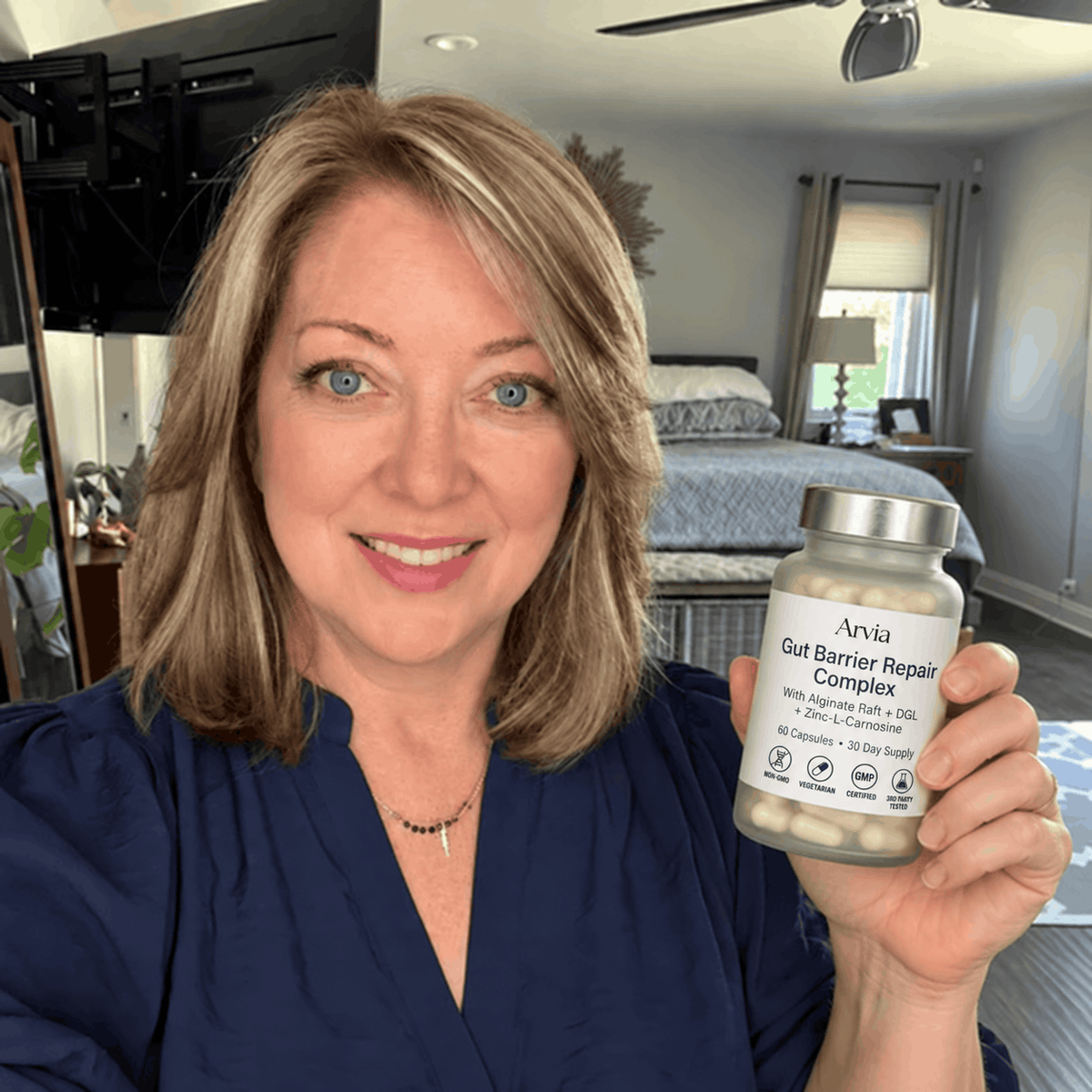
Noticed a reduction in acid episodes while lying flat*
Felt comfortable eating a wider variety of foods again*
Reported less burning, pressure & throat discomfort*
Days 1-3
Weeks 1–2
Weeks 3–4
Months 2–3
Your PPI reduces how much acid your stomach produces. That's one job. But the valve at the top of your stomach is still open — and whatever acid remains still pushes through it into your esophagus. Pepsin, bile, and digestive enzymes come with it, none of which are affected by a PPI. Your PPI turns down the acid. It doesn't block what still gets through. That's why you can be on omeprazole for years and still wake up burning at 2 a.m.
Arvia addresses reflux differently from a PPI. Instead of suppressing acid production — which triggers your body to produce more acid-making cells over time — Arvia physically blocks acid from reaching your esophagus while supporting the tissue that's already been damaged. There's no acid suppression, no rebound dependency, and no accumulating side effect profile. Many customers start Arvia while still on their PPI and taper gradually with their doctor's guidance. We don't tell anyone to quit their medication cold — that's a conversation between you and your doctor based on your results.
A hiatal hernia means part of your stomach has pushed up through the diaphragm, pulling the valve open. Acid sits right at that opening — all day, all night, every time you lie flat. That's the crushing pressure, the tight throat, the chest pain. Arvia's alginate forms a gel raft that floats directly to that opening and blocks acid from getting through. It doesn't fix the hernia — that's a structural displacement — but it addresses the acid exposure the hernia creates. Once acid is off that tissue, the constant irritation around the valve stops and the muscle has an environment to recover tone it couldn't regain while being hit with acid every hour.
Gaviscon contains alginate, but in most formulations it's listed as an inactive ingredient — the active ingredients are aluminum and magnesium, which make it function primarily as an antacid. It calms the burn and leaves the valve open. Same dead end as the pills. Arvia uses sodium alginate as the active barrier-forming ingredient at a full 500mg dose, combined with zinc-L-carnosine and DGL licorice to repair the lining the acid has been damaging. Different mechanism, different format — a capsule you can carry anywhere instead of a liquid that passes through before the gel fully forms.
Everything you've tried — PPIs, antacids, dietary changes, wedge pillows — works on acid volume, trigger avoidance, or gravity. None of them physically sit between the acid and your esophagus. That's a different category entirely. The valve at the top of your stomach is open. Those approaches try to manage what leaks through it. Arvia's alginate forms a gel barrier that sits right at the opening and blocks the leak. You weren't doing it wrong. You were missing the one approach that addresses the valve directly.
Nighttime is when reflux does the most damage. You're flat, gravity is gone, and acid pools at the valve opening for hours. The alginate barrier forms after you take two capsules with your evening meal and physically blocks acid from climbing while you sleep. Most customers tell us the 2 a.m. wake-ups are the first thing to stop. Take it after dinner. The barrier does the rest.
This is the reason most people can't quit their PPI. Your body responds to years of acid suppression by producing more acid-making cells. When you stop, you don't get your original reflux back — you get worse. That's rebound, and it's what sends people straight back to the pill within a week. Arvia doesn't suppress acid. It blocks it physically. So there's no rebound when you adjust your dose. The barrier is there whether your acid levels are high, low, or bouncing back. That's why customers who taper their PPI with their doctor's guidance don't hit the wall they hit every time they tried before.
Two capsules after your largest meal of the day. For most people that's dinner, which means the barrier forms right before you lie down for the night. That's it. No food diary, no complicated timing. The alginate needs food and stomach acid present to form the barrier properly, so always take them with or right after a meal — not on an empty stomach.
The barrier works from the first dose — alginate reacts with stomach acid within minutes. Most customers notice less after-dinner burning and fewer nighttime episodes within the first week. The lining repair from zinc-L-carnosine and DGL takes longer — published research measures outcomes over 4–8 weeks. We include a 60-day money-back guarantee so you have enough time to feel both the barrier and the repair working.
Every dose on the label, nothing hidden. Sodium Alginate (500mg) — forms the physical barrier. Calcium Carbonate (150mg) — strengthens the gel structure and neutralizes acid on contact. Sodium Bicarbonate (30mg) — creates micro-bubbles that make the raft float to the top. Zinc-L-Carnosine (37.5mg) — binds to damaged tissue and supports lining repair. DGL Licorice (80mg) — rebuilds the protective mucus layer. Ginger Extract (40mg) — speeds gastric emptying so less pressure pushes acid upward. No proprietary blend. Vegetarian, non-GMO, gluten-free.
Standard-sized vegetarian capsules — smooth and not oversized. Take them with a full glass of water during or right after a meal when swallowing is easiest. If you have a diagnosed stricture or significant dysphagia, consult your doctor before starting any capsule-based supplement.
Then you pay nothing. 60-day money-back guarantee. Try it for two full months. If you don't feel a meaningful difference, email us and we refund your order. No hoops. info@tryarvia.com — a real person replies.